Start outside, in the fall
The most common freeze split we repair each spring is self-inflicted: a garden hose left connected all winter. The hose traps water in the faucet body inside the wall; that water freezes, splits the pipe, and the damage hides until the first spring watering floods the basement wall. Disconnect hoses, close the inside shutoff for each outdoor faucet, and open the faucet to drain what is left.
While you are outside, note where your water service enters and which pipes run along foundation walls. Those are your freeze candidates, and they are easier to insulate in October than to repair in January.
Insulate what the cold can reach
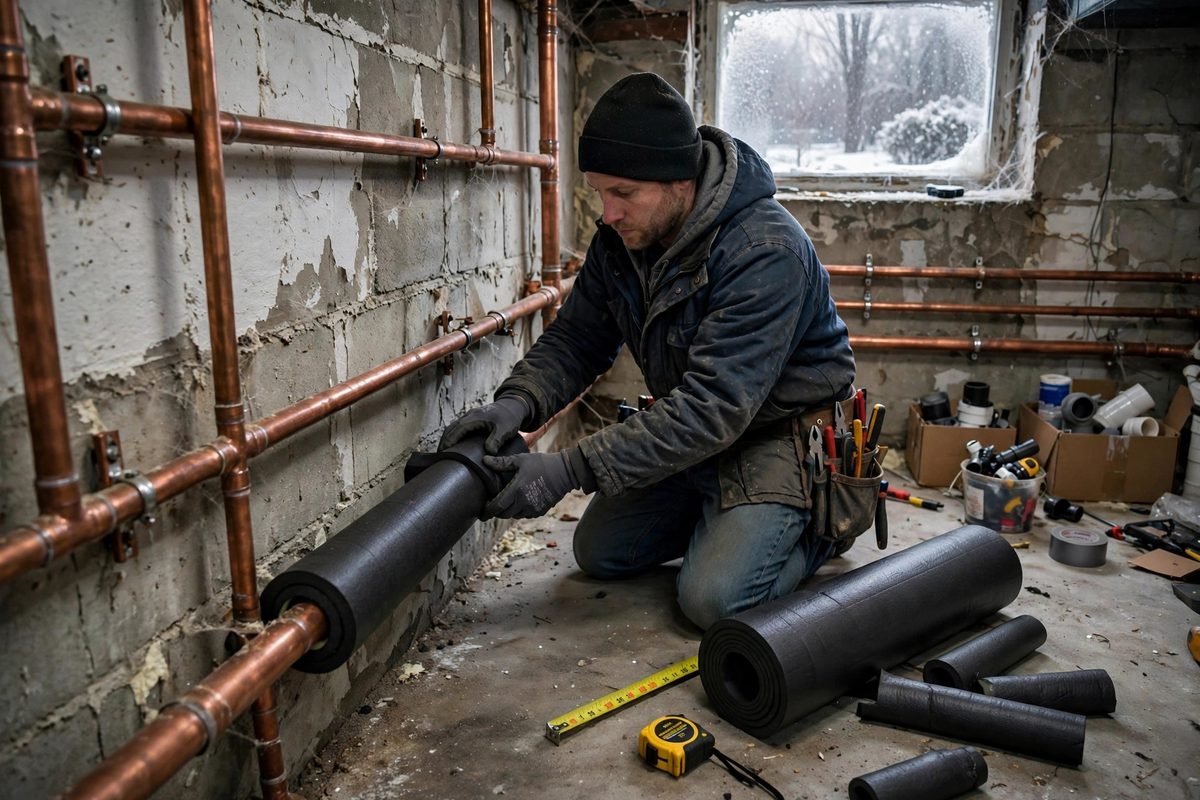
Foam pipe insulation is inexpensive and installs with scissors and tape. Prioritize pipes in the basement along exterior walls, in crawl spaces, in the garage, and in any unheated utility area. Pay attention to elbows and the pipe nearest the sill plate — the coldest spots are where drafts enter, and sealing those drafts with caulk or foam helps as much as the insulation itself.
For a pipe that freezes despite insulation — some locations are just too exposed — electric heat cable, installed correctly and paired with insulation, is the permanent answer. A pipe that freezes every year is not unlucky; it is misplaced, and rerouting it inside the heated envelope is sometimes the honest long-term fix.
During the cold snap
When temperatures head for the teens or below, open the cabinet doors under sinks on exterior walls so household heat reaches the pipes. Let a faucet fed by an exposed line drip slowly — moving water resists freezing, and the drip also relieves pressure if ice does form, which is what actually prevents most bursts.
Keep the thermostat consistent; a deep nighttime setback saves little and risks a lot in an older house. If you travel in winter, leave the heat on at a reasonable setting, and consider shutting off the main water valve and draining the system — or ask us about a proper winterization, which beats a neighbor's phone call about water in your driveway.
If a pipe freezes anyway
You will know by a faucet that gives nothing or a trickle. Open that faucet and leave it open. Warm the pipe gently — a space heater aimed at the area, a heating pad, a hair dryer kept moving — and never a torch or open flame, which starts fires and can boil water in the pipe into a burst. Work from the faucet back toward the cold area.
As the ice melts, watch for leaks: the pipe may already be split, and thawing is when the water arrives. Know your main shutoff's location before you start. If you cannot find the frozen section, if multiple lines are frozen, or if a split reveals itself, call us — freeze calls are the core of our winter in Westchester, and we are set up for them around the clock.
Questions homeowners ask about this
At what temperature do pipes freeze?
The risk becomes real when temperatures hold at 20°F or below, especially with wind and poor insulation — but the pipe's location matters more than the exact number. A pipe in a drafty crawl space can freeze at temperatures a well-insulated interior pipe shrugs off.
Should I drip all my faucets on cold nights?
Just the ones fed by vulnerable lines — typically fixtures on exterior walls or over unheated spaces. A slow drip (about a pencil-lead stream) is enough; you are relieving pressure and keeping water moving, not running a tap.