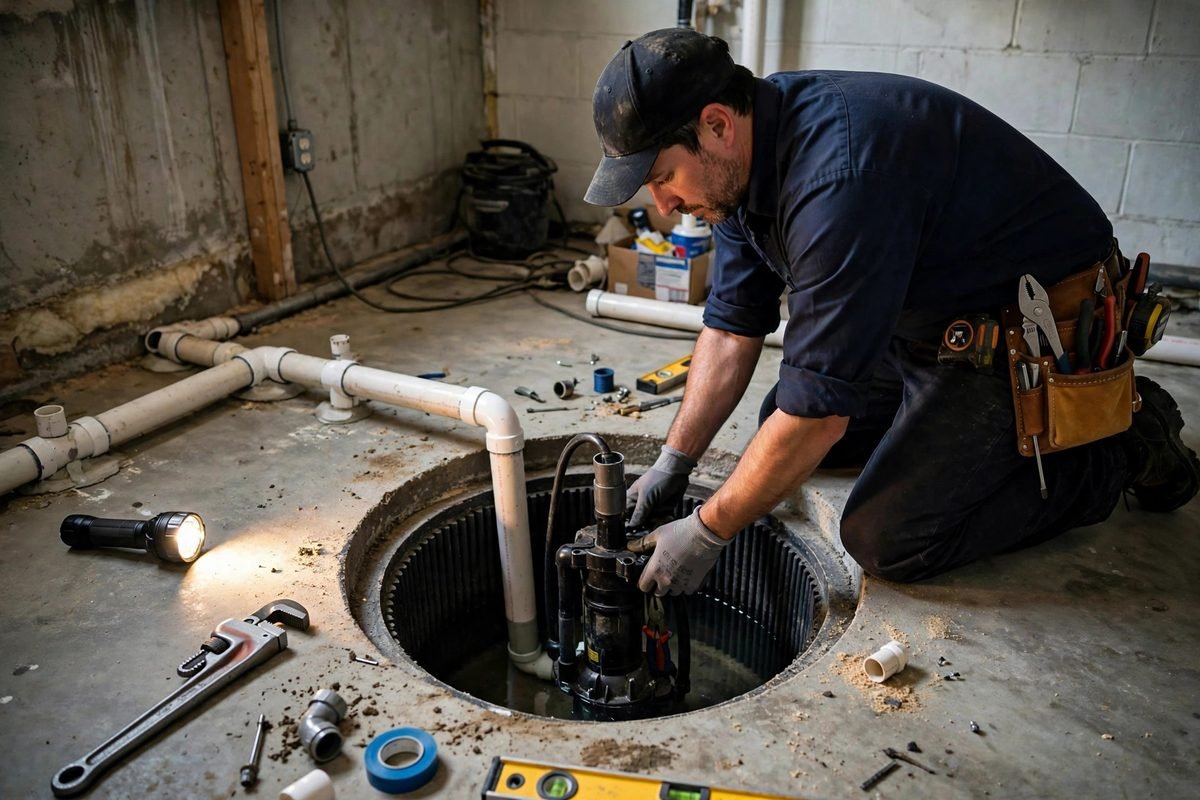
The five-minute test
Pour water in slowly and watch the sequence: the float should rise freely (a float tangled in the pit wall or a cord is a common, silent failure), the pump should start without grinding or hesitation, and the water level should drop within seconds. Let it run through a full cycle. A pump that hums but moves no water has a jammed impeller or a blocked discharge; a pump that does nothing at all needs attention before the weather provides its own test.
While the pit is in front of you, clear out the gravel, construction debris and silt that migrate in over the years — the pit should be a clean well, not a sediment trap. Check that the lid fits; an open pit is a humidity source and a hazard for anything stored nearby.
Follow the discharge outside
The pump is only half the system. Walk the discharge line to where it exits: it should carry water well away from the foundation — several feet at minimum, ideally to a downslope — and it should not be crushed, disconnected at a joint, or buried under a new garden bed. A pump that discharges beside the foundation is pumping the same water in a circle.
Check the check valve too (the one-way valve on the discharge pipe, usually just above the pit). If you hear a loud bang when the pump stops, or the same water cycles repeatedly, the valve is failing and the pump is working double shifts — shortening its life for nothing.
The power outage question
Here is the uncomfortable arithmetic of sump pumps in Westchester: the storms that bring the heaviest rain are the storms that take down power lines, and a primary pump without power is furniture. If your basement is finished, stores anything you care about, or has flooded during an outage before, a battery backup pump is not an accessory — it is the system.
Battery backups need their own small maintenance: check the battery's charge indicator and water level (on serviceable batteries) each season, and expect the battery itself to be replaced every few years. Water-powered backups, which run off municipal water pressure, avoid batteries entirely where the home's water pressure supports them — we can tell you whether yours does.
Replace on your schedule, not the storm's
Primary sump pumps typically last 7 to 10 years. If yours is in that range, makes new noises, or runs constantly even in dry weather (a sign of a stuck switch or an undersized unit working too hard), replacing it in a calm month costs the same as replacing it during a flood — minus the flood.
Spring is the right season for all of this because spring is when White Plains basements meet the water table: snowmelt plus April rain is the annual exam. A five-minute test in March is the cheapest insurance your finished basement will ever get.
Questions homeowners ask about this
How do I know if my sump pump is the right size?
Watch it during a real rain: if it runs in short bursts and keeps up, it is sized about right. If it runs nonstop and the pit still gains, it is undersized or the inflow is exceptional; if it cycles every few seconds in moderate rain, the pit or the pump sizing is off. A service visit can measure and tell you plainly.
My pump pit is dry all winter. Is that normal?
It can be — some pits only see water seasonally, which is exactly why testing with a bucket matters: a pump that sits dry for months can seize or its float can stick, and the first spring storm becomes the test it fails.